
Over The Counter, or OTC, trading is a way of selling and buying financial instruments directly between two parties without the need for an intermediary like an exchange. OTC Trading is decentralized by its very nature as it relies on decentralized networks to carry out its transactions. In Darley Technologies case, you will be able to speak and trade directly with our certified traders once onboarded.
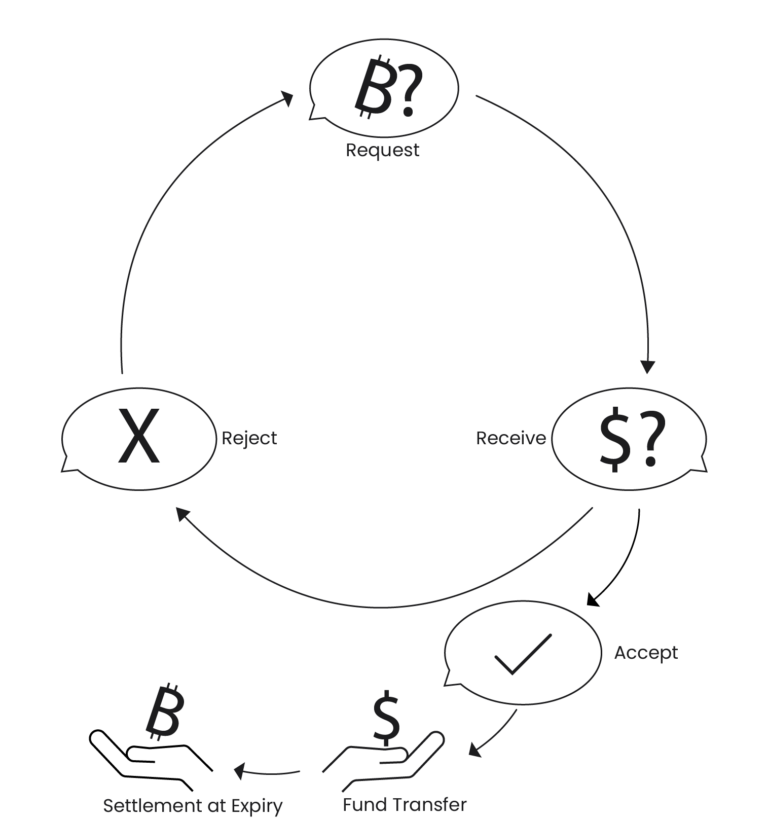
OTC Trading is quite simple, here’s a step by step breakdown of how it works with Darley:
1. You request a quote from our traders on any coin or digital options strategy you want.
2. Receive price from our traders on said coin or strategy.
3. You can choose to accept or reject this offer. If you accept we move on to step 4 and if you reject it then we work with you to get a quote you’re satisfied with.
4. Funds are transferred to settle the initial premium.
5. We settle the option at expiry.
Here is a simple diagram to visualise this process
| OTC | Exchange | |
|---|---|---|
| Flexibility | Custom orders | Limited |
| Slippage | Prices Locked before execution. | Susceptible to large slips in price. |
| Privacy | Entirely private, your trades are not public. | Trades must be made public. |
Execute large trades without impacting the market.
As a treasury tool to generate income, manage risk, and improve budget planning.
Get access to complex and custom structures. Satisfy all of your trading needs.
Trade on non-listed options underlying. That means an option for any coin you want.
Options are a powerful financial tool in the right hands but are currently a niche product in the financial world, reserved only for the people with the knowledge to use them. With this section you’ll gain a basic understanding of options which will be broken down into 4 sections:
An option is a derivative contract that gives the buyer the right, with no obligation, to buy or sell the underlying crypto coin at a specified price at expiry. That specified price is called a strike price. The specified date is referred to as the date the option matures or date of maturity.
Two key concepts underpin options trading: premium and leverage.
The premium is the price paid to purchase an option. Since options do not have to be exercised, this premium represents the maximum possible loss for the buyer (assuming the option is not sold or shorted).
The cost of an option is influenced by several factors, including:
The true power of options lies in their nonlinear leverage.
When you buy an option, you are gaining exposure to the full notional value of the underlying asset for only a fraction of its price. This creates leverage that goes beyond simple borrowing:
With perpetual futures (perps), leverage is linear and tied to margin (e.g. 10× means 10× exposure with liquidation risk)
Options offer flexibility and can serve multiple purposes within a trading or investment strategy.
Speculation
Options allow traders to profit from price movements without owning the underlying asset. This makes them particularly attractive for expressing directional views with limited capital, especially when combined with leverage.
Risk Management
Options are an effective tool for limiting risk:
This makes options particularly useful for managing uncertainty.
Diversification
Options can enhance portfolio diversification and provide protection against downside risk.
For example, purchasing a put option can act as insurance on an existing position. If the asset’s price falls below the strike price, the option allows you to sell at that higher predetermined level, helping to offset losses.
Yield Generation
Options can also be used to generate consistent income by selling premium.
By writing (selling) options, traders collect the premium upfront in exchange for taking on defined obligations. This allows investors to earn yield even in sideways or low-volatility markets.
Common examples include:
Cross-Border Services Restrictions Darley Technologies AG
The information on this website is provided for general informational purposes only and does not constitute an offer, advertisement, marketing, promotion or solicitation of Darley Technologies AG’s services, including its crypto options liquidity provision and OTC trading services, in any jurisdiction.
Nothing on this website takes into account the objectives, financial situation or needs of any person or entity, whether or not they are a client of Darley Technologies AG. Nothing on this website constitutes investment, tax, legal or other professional advice. In particular, no content on this website is intended to serve as, or form the basis of, advice, a recommendation, a binding offer or an invitation to make an offer, by or on behalf of Darley Technologies AG, to enter into any OTC transaction, to buy, sell or trade any crypto assets or derivatives on crypto assets (including options), which may qualify as financial instruments within the meaning of the Swiss Financial Services Act (FinSA), or to use any of Darley Technologies AG’s services.
Darley Technologies AG provides its services exclusively on a reverse solicitation basis, meaning only at the sole and independent initiative of clients who contact us directly.
By accessing this website or engaging with our services, you confirm that:
Trading in crypto assets and derivatives on crypto assets, including options, involves substantial risk and may not be suitable for all persons. You should seek independent professional advice before entering into any such transaction.